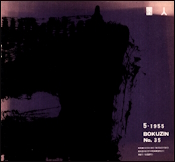
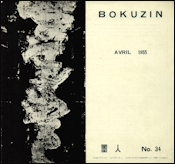
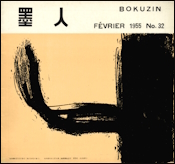
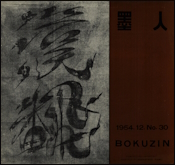
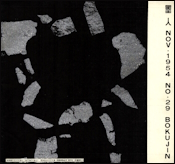
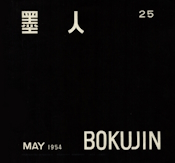
Founded in 1952 by Japanese calligraphers Shiryu MORITA, Yuichi INOUE, Sogen EGUCHI, Yoshimichi SEKIYA, and Bokushi NAKAMURA, the BOKUJINKAI, also known as “The People of the Ink,” is a calligraphy collective, research group, and exhibition society. Although still active today, it is primarily recognized for its contributions to avant-garde and modern calligraphy during the 1950s, both in Japan and internationally.
The establishment of the BOKUJINKAI occurred in a post-World War II context where Japanese calligraphy was perceived as outdated and stagnant. The formation of the group was marked by a break from the traditional calligraphy establishment and from another avant-garde group, the Keiseikai. The founding members of the BOKUJINKAI felt that the Keiseikai was too focused on internal conflicts and traditional hierarchies, thereby hindering the international development of Japanese calligraphy.
The BOKUJINKAI manifesto was published in the inaugural issue of their BOKUJIN review in April 1952. It criticized contemporary calligraphy as being impoverished and isolated from modern art, calling for calligraphy to open up to outside influences and artists in order to revitalize the medium as a form of contemporary expression.
The early years of the BOKUJINKAI were characterized by experimental works and efforts to push the boundaries of calligraphy. In Japan, the group collaborated with modern artists to innovate calligraphic practice and expand its domain.
In short, the BOKUJINKAI embodied a movement aimed at modernizing Japanese calligraphy, liberating it from traditional constraints, and opening it to international influences, thus contributing to its development as a contemporary art form.
However, over time, the group refocused on its own calligraphic practice and internal activities, gradually withdrawing from international endeavors. Today, the BOKUJINKAI focuses mainly on preserving the avant-garde style it helped create.
It is worth noting that during the same period, another art review, BOKUBI, burst onto the art scene in June 1951.
This publication was launched by MORITA before the formation of the BOKUJINKAI. BOKUBI's primary objective was to promote avant-garde calligraphy and serve as a platform for establishing contacts with international artists and art circles. It was intended for a broader public, including non-Japanese audiences, featuring multilingual translations, mostly in English and French, to help disseminate avant-garde calligraphy.
Established in 1952, BOKUJIN was specifically the dedicated review of the BOKUJINKAI. Unlike BOKUBI, BOKUJIN was primarily intended for an internal audience composed of group members and its supporters. It served as a platform for sharing information regarding the group's activities, research in calligraphy, and other topics related to their shared interests.
Due to its international focus, BOKUBI included a variety of materials, including exhibition reviews, research articles, visual analyses, as well as debates and discussions. It also featured international artists and content to foster the openness of Japanese calligraphy to foreign influences and audiences.
In contrast, BOKUJIN focused more heavily on the internal activities of the BOKUJINKAI, such as group exhibitions, calligraphy research, and discussions among members. It offered a space for group members and supporters to share ideas, works, and experiences related to calligraphy and the group's activities.
Although both reviews were linked to the BOKUJINKAI and contributed to promoting avant-garde calligraphy, they differed in their focus, target audience, and editorial content, with BOKUBI geared toward an international audience and BOKUJIN more tailored to the internal members of the group.
|