

|
|||||||||||||||||||||
 |
|||||||||||||||||||||
|
|
||||||||||||||||||||

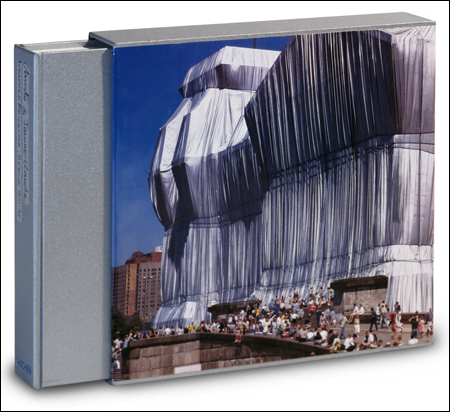
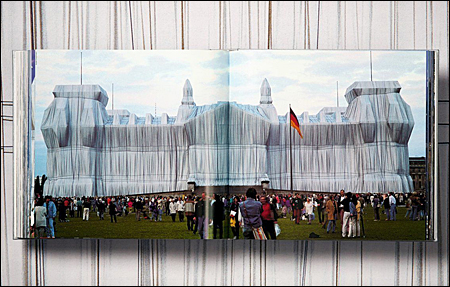
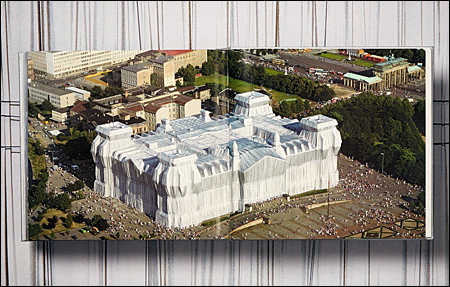
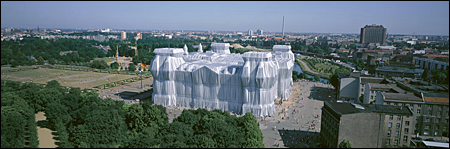
After a struggle that spanned the seventies, eighties, and nineties, the wrapping of the Reichstag was completed on June 24, 1995, by a team of 90 professional climbers and 120 installation workers. The Reichstag remained wrapped for 14 days, and all materials were recycled.
100,000 square meters of woven polypropylene fabric with an aluminum surface and 15.6 kilometers of blue polypropylene rope, 3.2 centimeters in diameter, were used for the wrapping of the Reichstag. The facades, towers, and roof were covered by 70 custom-tailored fabric panels, which was twice as much fabric as the surface area of the building.
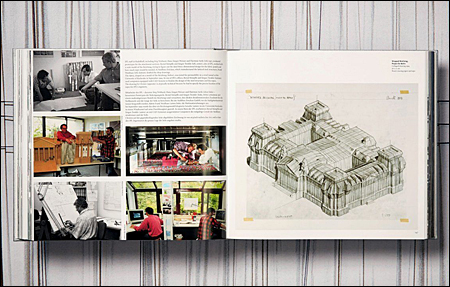
The artwork was entirely financed by the artists, as with all previous projects, through the sale of preparatory studies, drawings, collages, scale models, as well as early works and original lithographs. The artists accept no sponsorship.
The Wrapped Reichstag represents not only 24 years of effort in the artists' lives, but also years of teamwork by its key members Michael S. Cullen, Wolfgang and Sylvia Volz, and Roland Specker.
The Reichstag stands in an open, strangely metaphysical area. The building has experienced its own continuous changes and disruptions: built in 1894, burned down in 1933, almost destroyed in 1945, it was restored in the sixties, but the Reichstag has always remained the symbol of democracy.
Throughout art history, the use of fabric has fascinated artists. From ancient times to the present day, folds and fabric draperies have been an important part of paintings, frescoes, reliefs, and sculptures in wood, stone, and bronze. The use of fabric at the Reichstag follows this classical tradition. Fabric, like clothing or skin, is fragile; it conveys the unique quality of impermanence.
For two weeks, the richness of the silvery fabric, shaped by the blue ropes, created a sumptuous flow of vertical folds that highlighted the features and proportions of the imposing structure, revealing the very essence of the Reichstag.
(Text extracted from the website Christo & Jeanne-Claude)
information | purchases | contact
© 2025-2030 Frederic Dorbes - tobeArt Bookstore & Gallery
General terms and conditions of sale